HACCP CERTIFICATION
The HACCP system is a procedure control system guideline applicable to organizations dealing with manufacturing, trading, supply, retailing, packing, transportation, farming, etc. of food products. The HACCP system offers guidelines to recognize food safety hazards (physical, chemical and biological hazards), evaluate food safety hazards and perform food safety risk analysis.
It also covers establishing PRPs, setting product characteristics, identifying Critical Control Points (CCPs), establishing critical control limits, validation, verification and identification of potential emergency situations related to food safety.
HACCP (Hazard Analysis and Critical Control Points) is a preventative food safety management system in which every step in the manufacture, storage and distribution of a food product is analyzed for microbiological, physical and chemical hazards.
The effective implementation of HACCP will improve the ability of companies to protect and increase brands and private labels, promote consumer confidence and conform to regulatory and market needs.
HACCP can be applied to all stages of a food supply chain, from food production and preparation procedures to packaging and distribution. The Food and Drug Administration (FDA) and the United States Department of Agriculture (USDA) both require HACCP programs for certain food sectors, including juice, seafood, meat and poultry.
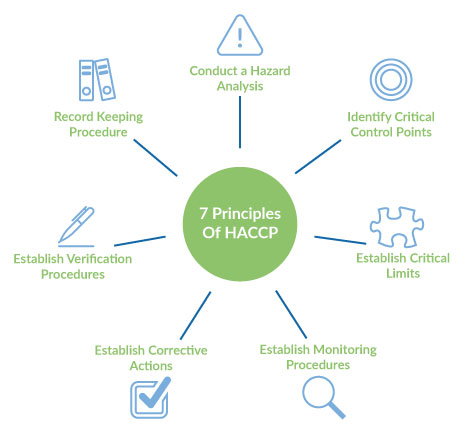
HACCP PRINCIPLES
- Determine Critical Control Points (CCP): For each identified risk, determine the appropriate critical control points.
- Application of Hazard Analysis: Identify and analyze potential biological, chemical and physical hazards associated with food production.
- Determination of Corrective Measures: Establish corrective actions in case monitoring shows that a CCP is not within the critical limits.
- Establish Verification Procedures: Establish procedures for verification and certification to ensure that the HACCP system is effective and functioning properly. Verification activities should involve authorized personnel and the HACCP team.
- Establishment and Management of Records: Maintain appropriate records and documentation related to the HACCP system.
- Establish Critical Limits: Define maximum or minimum values by which biological, chemical and physical hazards can be controlled.
- Determine Monitoring Processes: Establish procedures for monitoring Critical Control Points (CCPs).